
Searching Dent County Criminal Dockets
Missouri Case.net is the official public search tool for a Dent criminal case. Pick the live 42nd Judicial Circuit/Dent option first. If you know the full case number, use it. No number handy? Search by litigant name, then narrow the results with the criminal category, the filing year, and any aliases needed to separate similar Dent names.
Remember that the result list only points to candidates. It does not prove a person is the party in a case. Before opening a docket, compare the Dent location, the party role, the filing year, and the case category. The office that actually holds the record is Dent County Circuit Clerk Kristi (Morton) Craig, whose office handles Criminal and Drug Court along with the other circuit divisions. Case.net is a solid source of Dent public docket information, but a public display is not a certified judgment, and a missing document link does not mean no Dent document was ever filed.
- Open Missouri Case.net and select the live 42nd Circuit/Dent court scope.
- Search by the exact Dent case number, or use a litigant name with a narrow criminal category and year where available.
- Match the public Dent case header by location, category, party role, and filing date before relying on it.
- Read Dent docket entries in date order, then use Scheduled Hearings & Trials for a future setting.
- Call the Dent Circuit Clerk for the current procedure if an official or certified copy is needed.
Note: A Dent filing date is not an incident date, a hearing date, or a final disposition date.
Dent Criminal Case.net Search Fields
The state's published tracking instructions lay out four search routes: litigant name, case number, filing date, and Scheduled Hearings & Trials. Each one answers a different Dent criminal docket question. Have a known Dent case number? Search by number. Without a number, match names carefully. A date-range search works well for Dent cases by filing date, while the hearing search fits a public setting; for any Dent hearing question, check the calendar entry against the case docket itself.
Dent criminal case numbers carry meaning. Older ones use a two-digit year, a location code, a category, a sequence, and a suffix, while the newer statewide pattern uses a two-digit year, a location identifier, a category code, a five-digit sequence, and a subcase code. A Dent criminal category may show as CR, and older suffixes can use F for felony or M for misdemeanor. Treat those codes as clues for searching, not as findings about guilt or the Dent case result. Missouri Court Operating Rule 4 is the official source for the Dent numbering and record-access framework.
Inside a Dent County Criminal Docket
A Dent Case.net header gives the public frame. It lists the case number, location, criminal category, filing date, and current status or disposition where displayed. The charges area can identify counts or statutes. Still, a charge is only an allegation. The docket and disposition must show the court's result. Docket Entries supply the dated sequence. The hearings and trials section lists scheduled events. Those events can later be continued, vacated, or reset.
| Case number | Identifies the Dent court location and case category. A CR, F, or M marker must be read with the live header. |
|---|---|
| Charge or count | A Dent filed accusation or category as publicly displayed, not a final finding by itself. |
| Docket entries | Dent dated filings and actions such as arraignment, motions, a continuance, plea, order, or sentence. |
| Hearing setting | The Dent date, time, division or judge, and event type scheduled at the time of the search. |
| Disposition | The recorded Dent status or result. Check the final order or a later amended entry when accuracy matters. |
The official Court Operating Rule 4 materials set out the Dent record categories and the access limits that go with them.
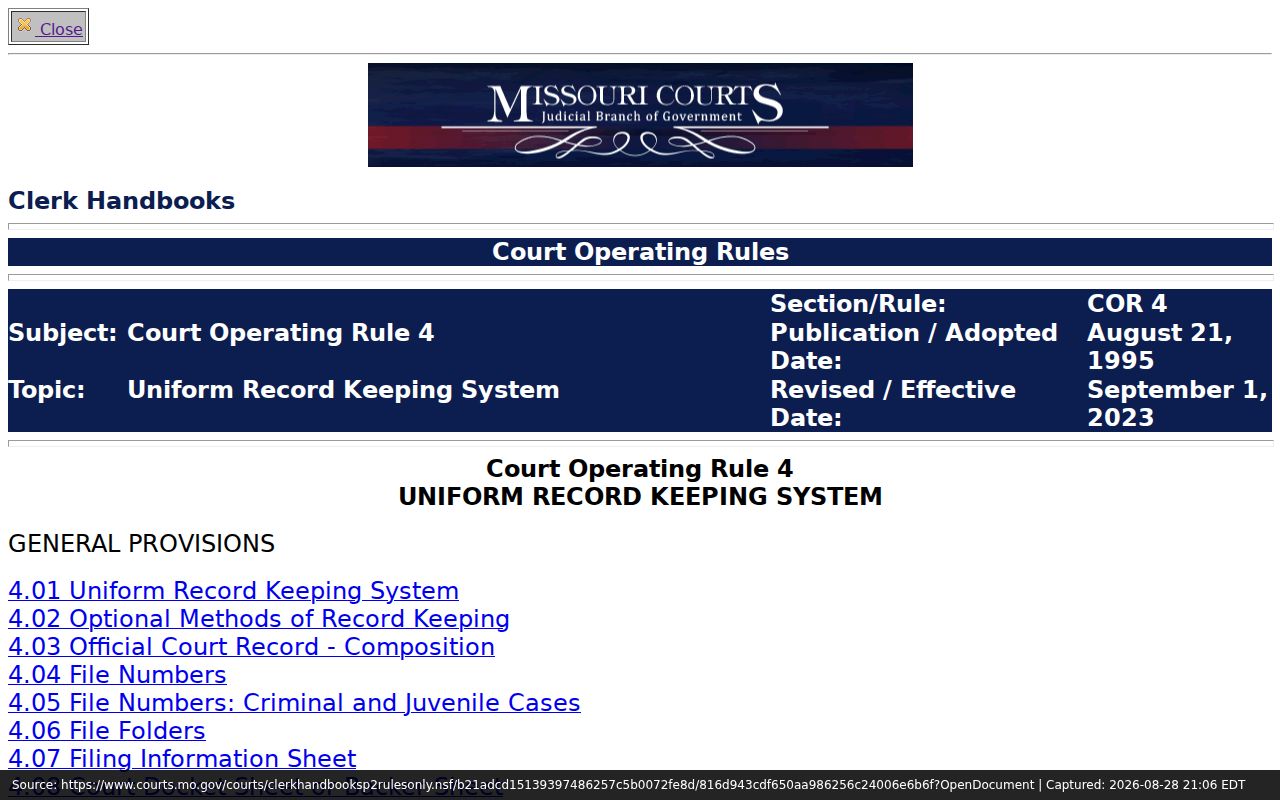
That rule-based access structure explains a common Dent pattern. A public Dent criminal docket can show an event while a supporting document stays unavailable through the public viewer.
Dent Felony Cases Move Through Divisions
The 42nd Judicial Circuit Local Rules cover several assignments. Dent misdemeanors and infractions go to the associate division. Dent felony cases before information go there too, along with certain other matters. So a Dent felony may first show a preliminary-stage event in the Associate Circuit Division. Later it can move to a circuit division. The trial court here is the 42nd Judicial Circuit Court of Missouri, Dent County. It is not a separate county criminal court.
This division map matters when a Dent criminal docket turns up under a different assignment than expected. A Dent misdemeanor or infraction may stay in the associate lane. An old Dent record with an X suffix can signal a boundover, transfer, or trial-de-novo context. "Bound over" is a procedural move beyond preliminary jurisdiction. It says nothing about guilt.
If a state-court judgment is appealed, the case goes to the Missouri Court of Appeals, Southern District. That appellate route sits apart from an original Dent criminal docket search.
How a Criminal Case Moves
A Dent public criminal docket can open with a citation or an arrest-related initiation. From there it may show filing, an initial appearance or arraignment, bond conditions, a preliminary hearing in a Dent felony matter, information or indictment, motion practice, plea or trial, judgment, sentence, and later post-disposition events. The exact Dent sequence varies. A Dent misdemeanor can be filed directly in the associate division, and any case may be dismissed, nolle prossed, diverted, transferred, or subject to a restricted-access rule.
Dent docket flow: Filing → Arraignment → Pretrial → Plea or Trial → Disposition → Sentencing
A scheduled Dent arraignment is not a completed arraignment. The same goes for trial dates. A future Dent trial date does not prove a trial occurred. Reopen the Dent docket after the date passes and look for an event, order, judgment, plea entry, continuance, or reset before describing what happened.
Dent Criminal Filings in FY2014
How much criminal work moves through Dent County? The FY2014 Missouri Judicial Report Supplement is the official tally. The numbers are historical, not current. Its criminal table counted 174 circuit felony filings and 272 associate felony filings. Misdemeanors split the same way. The circuit count was 32, with 354 at the associate level. The table also logged 70 infractions, 899 associate traffic cases, and 667 municipal-ordinance cases. All sat within 2,486 criminal-category filings.
Those counts describe one fiscal year, nothing more. They cannot tell you the size of today's Dent criminal docket or how any case ends. They do carry one practical lesson. A Dent docket search works best when you keep the division and category straight instead of treating every criminal entry as the same thing.
Courts That Hold Criminal Dockets
The Circuit Clerk in Salem keeps the records and settings for Dent circuit, associate, criminal, and Drug Court work. The official Dent County landing page sends court users to the Circuit Court Clerk and Case.net. There is no Dent-only criminal-docket application. The clerk's office sits at 112 E. Fifth Street in Salem, and the published phone numbers are 573-729-3931 and 573-729-9414 for routing questions.
Salem ordinance cases have their own local boundary. Under Local Rule 4.6, a municipality without a municipal judge routes ordinance matters through the associate circuit. Salem's code does exactly that, sending its ordinance cases to the Dent County Associate Circuit Court. Bunker is different. It holds a municipal-division certification, but that division spans Dent and Reynolds Counties. Check which court is actually named on a Bunker citation before assuming the Dent docket holds the case.
Authorized filers use the Missouri Courts Electronic Filing System. That system is for filing, not for reading a public docket. Anyone tracing a Dent criminal docket should start with Case.net, then ask the Circuit Clerk about a public terminal, a copy, or a certified judgment.
Reading Dent Criminal Docket Events
Docket entries carry weight, so read the words with care. A guilty plea or conviction marks a recorded disposition. A not-guilty entry records an acquittal. Dismissed and nolle prosequi are two different endings to a prosecution, and an SIS is a suspended imposition of sentence whose access treatment is set by law. Continued only means a date moved. A warrant is a process event, never a conviction.
- Arraignment
- An initial formal appearance or plea-stage event, not necessarily the end of the case.
- Preliminary hearing
- Associate-level felony review before information or indictment, not a trial verdict.
- Bound over
- A procedural move beyond preliminary jurisdiction, not a finding of guilt.
- Vacated or reset
- A setting was cancelled or moved. Check the next docket entry for the replacement date.
Note: Copy the portal's exact status and its date, and do not turn a charge label into a conclusion.
Dent Criminal Files and Certified Judgments
A public document link may be missing. Separate the docket event from the file behind it. Missouri File Viewer guidance explains that a linked document may sit behind its security level. An unlinked entry may have no attachment at all. It may simply be unavailable to that user. Older electronic records may live only on a courthouse public terminal. The Missouri Courts File Viewer Help page spells out that access boundary.
Need a certified criminal judgment or disposition? Contact Kristi (Morton) Craig's Circuit Clerk office with the full case number, the division, and party names. Give the exact document, its date, and whether you want a plain, certified, or authenticated copy. Dent publishes no official copy-fee schedule. Ask for the current quoted amount along with payment and delivery instructions before you send the request.
Sealed Dockets and Public Access
Public access runs case by case and document by document. A Dent criminal case header or docket event can be fully visible. A report, attachment, or order may stay restricted. Juvenile, drug-court, presentence, probation, parole, grand-jury, protected search-warrant, victim, sealed, and expunged material. Each kind follows its own access rules. A missing public document is never an invitation to hunt for a workaround.
Key Rules:
Missouri Court Operating Rule 4 sets the statewide court-record framework, including public search fields and sealed or confidential material.
RSMo § 211.321 makes juvenile records confidential except for the statutory exceptions or authorized court access.
RSMo § 610.105 governs closure for specified dismissed, nolle-prossed, not-guilty, and SIS matters, with stated treatment for disposition and final-order boundaries.
Restricted material has one lawful route. An authorized person goes through the Circuit Clerk and the applicable court procedure. Even with the case number in hand, the public result may stay limited.